UPDATE

AS OF JANUARY 1, 2013 - POSTING ON THIS BLOG WILL NO LONGER BE 'DAILY'. SWITCHING TO 'OCCASIONAL' POSTING.

Showing posts with label relationships. Show all posts

Monday, November 26, 2012

IN ONLINE RELATIONSHIPS: Warning Signs to Look Out For

EOPC's comments in dark blue.
by Jennifer M. Good

If you are in, or are interested in being in, an online relationship, it is important to know what things to look out for so you don't get hurt -- physically or emotionally. The advice you'll find below is meant for you to use as a way to help protect yourself from getting hurt. The tips are mostly common sense, but sometimes when it comes to love, it's good to have it written down for reference.

Person is too secretive.This can be as simple as the person is insecure with letting out information about themselves, to the person being married or living with someone else.

Person is often flirting with other people online.
Just as in real life you can find "players" online. Watch how your online interest interacts with others. You'll learn more about them, as well as be able to spot any unusual interests.

Person wants too much information about you right away.
Unless you are 100% completely comfortable about this person, don't give away any personal information. Even then, it is a good idea to keep important information to yourself. (if they do this - they are PROFILING you, MIRRORING you and BRAINWASHING you!)

Person seems only interested in cyber or phone sex.Unless this is something you are interested in, this relationship is probably not going very far. (If they don't want to meet for lunch or dinner or spend any time with you - if they live close - ditch them. They are using you like an "online hooker".)

After trust has been established, person will only give you a pager or cell phone number, but not a home number.
This again could just be precautionary, but again, it could indicate a cheating heart. (married or involved?)
After enough time has developed, person is adamant about not meeting in person. The reason for this could range from the person hiding something about their physical self, their lifestyle, other romantic involvement's, or just protecting themselves. (excuses can range from "I don't think I can control myself with you" to "I don't go out/ have time" to "I don't think its a good idea")
Person wants you to move to local area or in with them after only one or two meetings, or less than one year.
While my husband and I broke this rule, I strongly urge other couples to really get to know each other in person. It worked out well for me, but if follow this advice you will find yourself more confident about your choices if you really take the time to know them in person before deciding to make the big traveling step.

You find the person posting other personal ads online.
An obvious heartbreak! (especially if they are posting at BangMatch.com or Eroticy.com, etc.... sex partner sites, while trying to lure YOU into and keep you in an EMOTIONAL relationship online so they can use & manipulate you further)

Person keeps e-mails from other people hidden or a secret.

Something to keep an eye out for. Any relationship that begins or is involved in secrecy has it's days numbered. (OR...... they tell you not to talk to so & so online and you later find they told the other person not to talk to YOU either!! and give each of you bogus reasons to no longer talk. If THAT happens MAKE IT YOUR BUSINESS TO CONTACT THE OTHER PERSON IMMEDIATELY!)
Person asks for money or other help or even suggests they are broke.

You may feel comfortable with this, but it's not a good idea, especially if your just met them. Don't open yourself to a potentially huge loss.
Person won't let you mail cards or other gifts to home address.

This is also another sign of a possible romantic interest living with them. Take the extra precautions to make sure your online interest is not already involved with someone. (they won't even GIVE you a home address! Run!)

Every tip is dependent upon your instincts. What is good for one person may not be good for the next. Use your head, and your instincts. If something doesn't feel right, question it and resolve it quickly. You may discover it was a case of doubt, but you may also discover it wasn't!

Wednesday, May 16, 2012

The Importance of Erasing Your History if You're an Abuse Victim

SOUTH DAKOTA, USA - A Sioux Falls man is accused of tying up and beating his girlfriend after discovering she had used the Internet to research how to leave an abusive relationship.

Police spokesman Sam Clemens says 20-year-old Jose Sanchez allegedly tied up the 18-year-old woman with a belt and electrical wire and then beat her for about 20 minutes before she persuaded him to take her to a hospital.

A judge set bond for Sanchez at $10,000 on charges of aggravated assault, kidnapping and interference with emergency communications.

A home telephone listing for Sanchez was disconnected on Wednesday.

Thursday, April 12, 2012

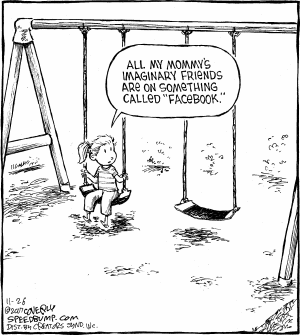
Facebook Rage

Once again - the victims are being blamed or called obsessed! Why are cheaters, liars and players FRIENDING their victims and/ or putting their business on Facebook in the first place? If they weren't acting like narcissistic creeps - there wouldn't be a problem.

And what about 50 year old married people who put their spouses and buddies on Facebook to make themselves look like good people (like Beckstead or Dunetz!) and then prey on vulnerable people on loads of other sites... all the while pointing to their Facebook saying "see, you can trust me!" - EOPC

Funny Pictures, Images and Photos

Social networking sites are causing an outbreak of jealousy among partners of online fans that researchers have dubbed "Facebook rage".

Suspicious lovers find it so easy to trawl profiles for photos or messages that may show their partner is a cheat (or misinterpret things on Facebook) that they become obsessed.

And the more time they spent with their online surveillance, the more jealous they feel, according to the study by the University of Guelph in Ontario, Canada.

Psychologist Dr Brenda Wiederhold said: "This new forum might be impacting the dynamics of adult relationships."

Sunday, February 12, 2012

Red Flags!

1. Be wary of the guy who is busier than the President of the United States. Doesn't have the time to see you. Has too much work to do.
- Volunteers for additional assignments.
- Needs to wind down-with his buddies in a bar-rather than spend time with you.
- Doesn't know if he can "control" himself with you.
- Must spend more time with his children. Must do laundry. Must pay his bills.
- And the best one of all, must have "time for himself."

If he can't manage a few hours with you on a regular basis, his priorities are questionable. Chances are he is only paying lip service to how important you are in his life.

2. Be wary of the guy who can't be with you on important occasions: your birthday, Valentine's Day, when you need some emotional support, etc. (things even a GOOD FRIEND would do for you).
- If he can't rearrange his schedule to put you on top of his list, at least occasionally, you will always take a back seat to the rest of his life.

3. Keep a record, however brief, of his stories, missed appointments, too tired to chat, says GTG and yet you still see him online and all excuses. Save all chats even if he asks you to delete them!
- Pay attention to the details. A liar eventually trips up over his own lies.
- Has trouble remembering what he said the last time he spoke to you. Has trouble juggling his lies.
- If his responses sound vague or hesitant, something is wrong.
- If his stories, dates, or excuses change from day to day, something is wrong.
- If he tells you NOT to tell people about you & he, or to talk about your relationship with people you both know: WARNING. He needs to keep you and his other targets apart so you don't compare notes and catch him lying.

4. If his stories are too fantastic to be believable, they probably are not to be believed.
-Tales of exploits that are more appropriate for the pages of a Tom Clancy novel are especially suspect. (like William Michael Barber)
-Also, be wary of stories designed to elicit sympathy, i.e., dramatic or morbid deaths in his history, unusual or unexplained illnesses, or marital unhappiness etc.

5. Be wary of the guy who equates truthfulness with confrontation. Turns the tables on you. Makes you feel guilty about asking questions. Accuses you of doing things he is actually doing (PROJECTION).
- If he backs away from your inquiries, it's probably because he is less than truthful himself, and his life cannot bear close scrutiny.

Photobucket - Video and Image Hosting

6. Neither a lender nor a borrower be. Keep what is yours yours until the signing of the nuptials. (and even then!)
- Loaning money to a lover can upset the balance in a romantic relationship. No matter how noble or unselfish your intentions, he feels emasculated. Or he's using you as an ATM.
- Don't waste your efforts; if he is in the least insecure (a likely possibility), he will resent you for your actions.

7. Be wary of the guy who uses his children as an excuse not to see you (like Robert Darden). He may say it's too soon to meet his children; he doesn't want them to develop a fondness for you and then get hurt if things don't work out.
- That may be a legitimate concern in the beginning of a relationship - after all, no one wants a steady stream of lovers in their children's lives.
- Something is definitely wrong, however, if after several months, no attempt is made to involve you in their lives. More likely, the problem is not with the children but with the father.

8. Be concerned if you don't meet his friends.
- Either he doesn't have any, a sure sign of problems, or he doesn't want you to meet them perhaps because you may find out something you shouldn't.

9. Be suspicious if he won't introduce you to his family.
- The reason may be that he is not as serious about you as he claims to be or that he is afraid you will find out something you shouldn't. (like Yidwithlid)

10. Be suspicious of the guy who is unreachable. His cell phone is turned off for long periods of time. Or he doesn't return your calls until hours later. Or he is afraid to give you the number.
- If he claims he didn't get your calls or repeatedly blames the workmanship of his cell phone, recognize that for what it is: an excuse.
- He doesn't care about you enough to give you the number - something he'd give to a business acquaintance. Time for you to leave.

11. If he doesn't show up when he says he will, and worse yet, doesn't call with one heck of a good excuse, cross him off your Christmas card list.
- Standing up a woman is a sign of disrespect. If you excuse the behavior once, twice, thinking you are being understanding, you are just asking for more of the same.

12. Be VERY wary of the guy that runs hot and cold.
- First, he can't get enough of you; then all you get is days or weeks of total silence. Play the game by your rules, not his; your schedule, not his. Get on with your life; don't wait for his change in mood or affection. He may be 'grooming' you (seducing) to use & abuse later. (like Beckstead)
- His controlling behavior only serves to make you a victim of his mercurial and thoughtless whims.

13. Listen to your friends. Ask them what they think.
-They have your best interests at heart and are not likely to be blinded by your friend's charms. Hopefully, they will think enough of you to be truthful. If no one sees in him what you see, there is something wrong.
- Again, if he tells you NOT to tell your friends about you & he and/or doesn't want to meet them... drop him.

14. Check out your lover.
- Run his name, nicknames, and email addresses through a couple online search engines. Read EVERY PAGE.
- Hire a detective to establish the basics. Be observant.
- If you get a chance to visit his home, carefully examine your surroundings. Study photos on the wall. Certificates. Look at albums. Anything to establish he is who he says he is.
- If you know where he works, see if his company has a website. Make sure his description of what he does for a living tallies with what you learn. Cross check the work number that he gives you to the number that is listed in the phone book.
- Ask him to go to lunch. Meet him at his office. If there is any resistance to this suggestion, be wary. Why doesn't he want people to know he knows you??
- If a divorce is in his background (a likely possibility for those of us over 50) and he is from your area, spend time at the local courthouse. Some public records are available to the public. While you should not believe everything that is said by warring partners, you will get a sense of what you might have to face yourself. (If he's not from your area - again, try an internet search!)
- And while you are at it, check to see if there are any criminal or civil proceedings lodged against him.

15. Invest in a phone with caller ID. Screening your calls is not the only purpose for this useful function; you will also get a pretty good idea of where your guy is when he calls.

16. Learn to recognize inappropriate behavior for what it really is: behavior that you really don't want in your life on a permanent basis.
- Trust in your own common sense. You are a valuable person and deserve to be treated with respect and dignity; if you don't get that, move on. There are others who will appreciate your value.


"Never Too Late to Learn"
(56) Bethesda, Maryland


FROM DateSmart.com

(this article uses the male gender, yours may be female)

Thursday, February 02, 2012

IF YOU LOVE ONE OF THESE, A BOOK OFFERS HELP

By KRISTIN DIZON

Jerk. Witch. Creep.

You’ve probably used such names to describe a romantic partner gone bad, or maybe a few choice words of the four-letter variety.

But, there’s another name for the ones who are so self-absorbed and self-centered that all of their needs and wants come first: the narcissist.

He’s the boyfriend who begs you to leave your job, family and rent-controlled apartment to move to another state to be with him, only to discover, after moving, that he’s got another girlfriend he failed to tell you about.

She’s the girlfriend who creates a crisis out of every little situation so she can be the perpetual look-at-me center of attention and drama.

It’s the father who chose to play golf instead of help with his young son’s birthday party, despite his wife’s pleas. Then he arrived when the party was almost over, crushing his son’s feelings.

All of these are examples from flesh and blood people in the new book, “Help! I’m in Love With a Narcissist,” by relationship authors Julia Sokol and Steven Carter. (M. Evans and Co., 270 pages).

Previously, they wound up on the best-seller list for “Men Who Can’t Love,” in which they coined the now ubiquitous term, “commitmentphobia.” Now, they’re throwing our self-obsessed, me!, me!, me! approach to relationships under the microscope.

We live in narcissistic times. We observe every move of Paris Hilton and P. Diddy, and lavish attention upon arrogant business moguls like Donald Trump.

Reality is, most of us have some degree of narcissism and self-centeredness. But there's a big difference between garden-variety narcissistic tendencies and toxic narcissism.

Narcissists are often charming, adventurous people who entertain us with their interesting stories and grandiose sense of self. They are often very attentive and appreciative toward their partners for the first month or two, and are skilled at fanning the chemistry.

But, they also know how to demean, criticize and show no empathy for others. They're often controlling and have a needy side that asks frequently: Do you really love me? Will you leave me? Are you like all of the others?

Many have a history of troubled relationships and lots of emotional baggage.

They take, they demand, they expect. In return, they give very little, although many are good at delivering flowery words of love that suck us back in, especially after a fight or ultimatum.

But, how do you know if you're living with a narcissist? The bottom line is that if you're in a relationship that's dominated by the other person's wishes and priorities, without the normal give-and-take and compromise, you very well may be shacking up with a narcissist.

Sokol recently spoke with us from her Rhode Island home about living with and loving narcissists.

Who did you write this book for? And why the need for it?
"We're writing it for everybody who doesn't quite understand why they're getting stuck in the same relationship -- one that revolves around the other person. ... I think it's very widespread. And we also did this book to help readers understand their own narcissistic issues. That will help you understand the choices you make and why you're drawn to a particular type of person. Most of these people who get into these hideous, hideous relationships, one after another, complain that they were bored with other people."
What separates average narcissistic qualities from a true toxic narcissist?
"I guess it's how much pain that person is causing and how unable and completely incapable the toxic narcissist is to feel anything for another person. The narcissist is able to weave this terrific web of fantasy and illusion. It's fulfilling all your fantasies, all your dreams. You've always wanted to feel unique and special and the narcissist is able to make you feel that and that this is a unique and special relationship."
Why do people fall for narcissists?
"I think society places a value on narcissism and narcissistic values. We put an emphasis on the superficial. We put an emphasis on the people who sound as though they know what they're talking about, even when they don't. ... Narcissism forgives an awful lot that in an earlier time would have been considered obnoxious. Modesty is no longer a virtue in this country. Narcissists tend to tell you that they're wonderful and terrific and adorable. ... They tend to know how to sweep people off their feet. They are incredibly seductive. They know what you like to hear."
A lot of folks seem to believe that with enough love and hope and effort, the narcissist in their life can change. What do you think?
"After years of hearing these stories -- and we've heard thousands of them -- they don't ever seem to change."
How does one's upbringing tie into loving a narcissist or becoming one?
"Many people have parents who have all-about-me tendencies -- everything comes back to that person. The child is the audience, the support system, a part of this drama. And then they turn around and find partners who pull us in this way. It comes from our own weak sense of self. ... Some are so spoiled by parents that they turned into narcissists."
Why are narcissists so hard to leave?
"Narcissism is also about feelings of sadness and depression. So the classic narcissistic partner has this 'look-at-me' quality, but also has this 'oh poor me, I really need help.' They draw you in with stories of their sadness and the emptiness and you feel that somehow you can fill this void. And you tell yourself, he really loves me -- even though he's cheating on me every other night of the week."
What's your advice for people to get out of a narcissistic relationship and break the pattern?
"You have to understand what attracts you to this person. You start setting up boundaries that you're not going to let people cross. You really start believing in the things that you say are important. You stop focusing on perfection, you stop worrying about being bored. And you stop feeling that you can solve the other person's problems. ... The minute you feel you're in this kind of relationship or you've had more than one person like this in your life, a little professional help is not going to hurt."
You and Steven Carter coined the term commitmentphobia. Do you think narcissist will become part of the dating lexicon?
"I think it's starting to do that already. And it's about time, too. I think this is the relationship issue of our times. There's nothing to curb people like these. They're in a society that supports it."


KNOW A NARCISSIST?

Here are the signs of narcissism. It takes five or more before you can slap the label on someone:

1. An exaggerated or grandiose sense of self-importance that isn't supported by reality

2. A preoccupation with fantasies of extraordinary success, wealth, power, beauty and love

3. A belief that he/she is special and unique and can only be understood by other special people

4. An intense need for admiration

5. A sense of entitlement

6. A tendency to exploit others without guilt or remorse

7. An absence of meaningful empathy

8. A tendency to be envious or to assume that he/she is the object of others' envy

9. An arrogant attitude

SOURCE

Friday, October 07, 2011

Breakup then... Cyberstalk?


By Dane Schiller

Soon after a Massachusetts college student dumped her Houston-area fiancé, he sent her email and text messages to find out what happened, maybe win her back.

It didn't work. Things got ugly.

The ex-boyfriend is now accused of unleashing a torrent of hundreds of messages that grew so violent that the woman sought help from the FBI.

"I will tear you limb from limb," read one of the messages, according to copies shared with a magistrate. "I want to watch you suffer" and "I will come for you," read others.

Federal prosecutors accuse Christopher Hlavinka, 24, of using the Internet to cause "substantial emotional distress." He faces up to five years in prison if convicted.

On Tuesday, U.S. Magistrate Judge Stephen Smith ordered Hlavinka, who was first taken into custody in June, to be released to his family pending trial. He also is to be tracked by GPS and largely confined to home and is not allowed to use computers or cell- phones with Web access.

One email can land him back behind bars and facing even more time.

Spotlight on stalking
The case highlights increasing concern about online harassment and stalking.

Hlavinka's former fiancée, identified in court by the initials S.H., was pushed to the edge by the harassment, according to the FBI. She moved multiple times to hide and sought psychological counseling as well as police protection.

FBI Special Agent Ryan McKee testified that Hlavinka mocked a protective order as well as police, and sent personal information about S.H. to her family and associates. "Jail does not scare me," Hlavinka reportedly told her. "Isn't it cute you think you can get protection against me?"

Hlavinka's computer showed he went to Google maps and other sites to research where S.H. and her parents lived, McKee said.

3 motivations
Defense attorney Brian Laviage argued for Hlavinka's conditional release at the hearing, saying his client has no criminal record; no history of physical violence; and that he belonged with his family and getting help rather than in prison.

He said Hlavinka's arrests, first by Fort Bend authorities and then by federal agents, and his time behind bars helped him accept that the relationship is over. He just wants to get on with his life, Laviage said.

David Buss, a psychology professor at the University of Texas at Austin, said by phone that stalkers usually exhibit three major motivations: They either want to get back together with the ex-partner, to interfere with an ex's romantic life, or to exact revenge.

"Cyber-stalking can be especially vicious because the stalkers are sitting behind computers, and so feel that they can stalk with the safety of their own house or work," he said.

original piece can be found here

Sunday, May 01, 2011

When The Cheater Finds You Have Been Spying

Photobucket - Video and Image Hosting


Dr. Robert Huizenga

My, how the cheating spouse/partner/ cyberpath cries foul when he/she discovers you are spying. (or found them out!)

Outrage can be intense: "How dare you!! I never thought you would stoop to that! How could you!? How can there be trust in this relationship if you do that? This is none of your business; I dont spy and go behind your back! Now you know why I want to pull away from you. How could I love anyone that would do something like that to me?" On and on...

Cheating husbands, cheating partners and cheating wives usually will not admit the duplicity of their clandestine behavior. But you are made out to be the villain if you use detective work to discover the truth. It doesnt make sense, but then again not much about infidelity borders close to sanity.

Are you a morally corrupt duplicitous character hell bent on destroying the integrity of a relationship through spying? No, of course not. The integrity of the relationship has been destroyed through the extramarital affair. The affair shattered the promises and mocked the vows that the two of you made.

Photobucket - Video and Image Hosting

You saw clearly the signs of a cheating partner. The affair invaded the domain of your marriage/relationship and crumbled its protective boundaries. The marital infidelity broke the contract of the marriage and the exclusivity of the relationship; it was the act of betrayal. Spying does not damage the marriage/ relationship. It is an attempt to seek the truth and resolve the pain and deception.

Spying is often used to grasp the reality of the situation. Its intent is to find the truth. Only the truth can provide a foundation from which to begin resolving the hurt, pain and forging a direction for the marriage or relationship and enable each person in the relationship to attain health and sanity.

Monday, April 25, 2011

Cyberstalking & Social Networking

More on the danger of Social Networking and Relationships that start online as well as Cyberstalking - EOPC

by Leah Shafer


Once upon a time, two people fell in love. It rocked.

They both changed their Facebook status to "In a Relationship" and posted pictures on their blogs of them kissing, laughing and frolicking. Then things went sour and they broke up.

In the olden days of, say, 2001, they would have parted ways and had little way to keep tabs on each other, outside of gossipy friends and occasional apartment drive-bys. Not anymore.

She watched his MySpace page and knew exactly when he started dating a new woman by his status updates. He looked at her Flickr photos and saw her having a great time at a Granada concert, and wondered, "Who's that guy?"

Cyberstalking is alive and well in the digital age, with many relationships continuing virtually long past the breakup through passive observation.

"It is creepy, but we're curious by nature," said Angela Faz, 31, who admits to mild curiosity about exes. "I try not to look!"

The view from online is tempting, because instead of driving by his or her house, you get an intimate view of your ex's thoughts, she said.

But that view can be painful, especially when the other person has started a new relationship or appears to be having a rollicking good time without you.

Oak Cliff resident Michael M., 33, is cyberstalking his ex and said he often wonders when the obsession will stop.
"I've found that since my breakup, I've had the need to keep up with my ex – is she dating, did she go to the fair this year (with whom?), what did she do for Halloween? Did she wear a costume we talked about last year? Is she keeping up with me, too?"


The situation is sort of like a sore in the mouth that would heal, if only you'd stop tonguing it.
"Am I doing it for pleasure – do I enjoy the torture and sometimes humiliation that goes with it?," Michael M. asked. "A friend once told me, 'You can glance at the past, just don't stare at it.' At what point does the staring begin?"


There's also a question of whether the observed person knows he or she is being watched and posts with that in mind. It could feel good to stick it to your ex by posting ambiguously sexual remarks on another (hot) person's profile.

Not that we would know anything about that. But even cyberstalking is still in relation to the two people involved and the length and intensity of their relationship.

The way this changes the psychological dynamics of a breakup is unclear – will it make it harder? Easier? Or just more complicated? Only time – and maybe a few SuperPokes – will tell.

SOURCE

Wednesday, February 23, 2011

Breakup Notifier


Waiting for that special someone to break up so you can move in?

Now you can get an email telling you when it's time start wooing.

A new site called Breakup Notifier lets you log in using your Facebook account, choose who you're interested in and then sends you an email when their relationship status changes.

"You like someone. They're in a relationship. Be the first to know when they're out of it," the site says.

In other words, forget about constantly refreshing a Facebook profile with the hope that the relationship status is about to change.

The idea came from the founder's efforts to find the perfect guy for his fiancee's sister. Dan Loewenherz, his fiancee and his mother found the right guy on Facebook only to learn that he was in a relationship.

So Loewenherz spent four hours coming up with Breakup Notifier, TechCrunch.com reported.

Breakup Notifier crawls Facebook every 10 minutes.

The site is now free but Loewenherz may charge .99 cents for early adopters and $4.99 at some point in the future, TechCrunch reported.

Saturday, March 27, 2010

A Slap in the Face(book)


By MARY TOOTHMAN

She had planned a life with him, she was devoted to his child. They had set up house together - she loved him.

But he ended the relationship. And there she was, alone and face-to-computer-screen with daily images of the man who broke her heart.

Once proudly listed for all of her Facebook friends to see as "in a relationship," Devon had to cope with a reality that failed-relationship victims have come to dread: the public Facebook status-change to "single."

There is certainly no shame in being single - but breakups in this age of fast-moving Internet updates involve a new spectrum of public involvement and awareness. Breaking up online, with an audience of hundreds, can intensify and prolong the agony.

The number of active members of social networking sites such as Facebook and Twitter are increasing at an astounding rate, and the impact of personal, yet oh-so-public postings are taking a toll. Facebook, which reports about 400 million active users, is often the medium by which friends and family - and sometimes even those involved - find out about the end of a relationship.

Devon, a Lakeland office worker whose real name is not being used for privacy reasons, did not actually learn her boyfriend wanted out from looking at Facebook. But after their "it's over" talk, it was verified when he changed his status to "single," - for all of their friends and family members to see.
"The status change was hard to see when he did it," she said. "This entire situation has been hard. I am soon to be 26, and I just want to find the right guy to marry, have babies, and grow old with. Facebook has made it difficult, but I'm not sure it would have lessened the blow even if he wasn't on Facebook."

While touted by many as a wonderful resource for friendships, support, reunions of out-of-touch friends and family and an efficient and easy way to share photographs, videos and information, social networking clearly has its drawbacks.

Berney J. Wilkinson, an Internet-savvy therapist in Winter Haven, pays close attention to the impact social networking has on emotions and the overall well-being of the population. He encounters social networking-related issues regularly when working with patients, and recognizes the differences they bring in today's online society.
"In the age of social networking sites, what were once personal conversations are now publicly broadcast around the world," Wilkinson said. "Prior to sites such as Facebook and MySpace, and networking applications such as Twitter, relationships were confined to telephone calls and social engagements.

"Whenever a couple experienced a 'bump' in the relationship, they would talk it out over the phone or in person, and attempt to work out their differences," he said. "In fact, just the other day, I was talking with a patient about how we used to make mixed tapes after breakups, just to have a collection of songs that defined that time of our life."

Although it was painful, Devon could not stop herself from checking out information posted on the profile page of her ex-boyfriend after they split up.

"It is hard to see what other girls have to say now that it is public knowledge he is available again," she said. "One girl posted 'It's officially official!' It sucks to see that, but what can I do? I can't make him love me."

Society as a whole could stand to alter the way postings are made thoughtlessly - and so publicly, Wilkinson said.

"Today, information spreads way too fast, and social networking sites have become the 21st-century water cooler, where everything is discussed and made public."

People often quickly post remarks or comebacks on the sites that are misunderstood or hurtful, and words cannot be taken back once someone reads them. In many cases, relationships that might have previously been salvaged are irreparable once the process is publicly recorded, he said.

DOWNSIDES OF SOCIAL MEDIA
There are two major problems with the sites, said Wilkinson, who has nothing against them and, in fact, uses them himself.

Relationship issues are often handled poorly, and the personal touch is eliminated. People often impulsively change their relationship status too soon, he said, and sometimes the person who was left behind in a breakup has to view photos and reports about a new relationship.

Breakups have lost quite a bit of dignity with the Internet.

"Prior to social networking sites, breakups had to be done in person," Wilkinson said. "In fact, people were looked down upon if they ended a relationship by note or by phone. Today, people readily use Twitter, Facebook, MySpace, and texting to manage their relationships.

"This removes any remnants of the interpersonal relationship and often results in cold interactions that lack connotative affect," he said. "Because a person can break off a relationship via networking, they do not see the person's responses, effect or emotions. As such, messages come across as cold, hurtful, and impersonal, further damaging each other."

Even some of Devon's friends, who probably meant well, posted remarks on her Facebook page that were hurtful. While crying and grieving, it was difficult to read messages about her newly single status, such as "Good!" or "Now we can go out and party!" - when she really just needed support and for friends to listen.

ONLINE SUPPORT
Wilkinson said with precautions, the sites can be helpful.

"Facebook (and other social networking sites) can provide significant support for people following a breakup," he said. "Friends who might otherwise know nothing about one's situation may ask to spend time with them to help them recover. I think that this is a very positive role that the networking sites can play."

But users must take care to weigh words carefully, he said, and always remember who can read them - and how they might be interpreted.

"I spend a lot of time with teenagers, in particular, who are dealing with issues related to the sites," he said. "Our personal lives are now broadcast for the world to see. While they definitely can be used for good, sometimes people just do not understand how much is lost in the printed word."

He offers some advice for dealing with online breakups, although he recognizes many may have trouble sticking with it. "Take a break from the social networking site, or at least don't visit your ex's page," he said. "Too many times, emotions get the best of us and we end up saying, doing or feeling things that hurt us in the long run. As a result, I often recommend that people avoid as many situations as possible that can continue to create or maintain emotional wounds."

For those who are going to read anyway, he said, "You sort of have to know going into it that you are not going to like what you see."

Of particular importance, ironically, is a suggestion most unlikely to be followed - that people keep their personal lives more, well, personal.

"Take discussions offline," he said. "Do not get into arguments or try to fix things through posts or status updates. Discussions of this type create more problems.

"Texting and posting online removes personal touches, affects, and feeling in what you are trying to say. So much is left between the lines. So jump back to the '90s, and instead of texting the person with your phone, call them."

Devon said she was unable to stop cyberstalking her ex-boyfriend, and he finally blocked some of his content from her. But her friends and family members still have access, and she continues to check it out. Still, she said, she's determined to move on.

"I am working on letting go," she said. "I just keep telling myself something better will come along soon enough."

And when it does? Her friends are likely to find out when they see her Facebook status change - to "in a relationship."

original article here

Tuesday, August 14, 2007

African Internet Bride Scam Victim Returns Home

A South Australian farmer held hostage in Africa for 12 days in an internet bride scam has returned home, saying he's lucky to be alive.
Photo Sharing and Video Hosting at Photobucket

Des Gregor, a 56-year-old from Hoyleton in SA's mid-north, arrived at Adelaide Airport tonight after being freed from his African captors who were ultimately duped by police.

Mr Gregor travelled to the landlocked west African nation of Mali last month to meet his supposed bride and collect a dowry of $100,000. (NZ $114,521) in gold.

But on his July 27 arrival, he was kidnapped by an organised scam gang, beaten, stripped, had his cash and credit cards taken, and was held hostage at an apartment in Bamako, the capital of the third world country.

The wheat and sheep farmer was told he would have his limbs hacked off with a machete unless he arranged a $100,000. ransom.

Mr Gregor was freed last Thursday when Australian Federal Police (AFP) persuaded the kidnappers there was money to be collected by their captive from the Canadian embassy in Bamako.

The conmen briefly released Mr Gregor, and police rescued him.

"I especially thank the Australian Federal Police for the effort that they put in and also the Mali police, they did a fantastic job in conjunction with the AFP, and if it wasn't for them, I reckon another couple of days and I wouldn't have returned," Mr Gregor said.

Asked if he had learnt his lesson, Mr Gregor replied: "I think so."

Mr Gregor arrived in Adelaide with none of his possessions and issued a warning to others seeking love over the internet.

"Just be careful, make sure you check everything out 100 per cent," he said.

Earlier, his brother Phil Gregor said Des was "absolutely blinded by the fact it was a scam".

"You see this in a movie, you read about it in a book – it happens to someone else, not you. But it does, I found that out," Phil Gregor said.

"I really hope that the message gets out to people that they look after their family and if anyone talks about internet relationships, that they can be open and share the mail with them to get an objective opinion.

"When you're in that relationship, it does seem that the reality of the scam doesn't show up to the person that is in it.

"I want people to be prevented from having to go through what we did.

"It's not a nice thing and it can be avoided with some family participation."


SOURCE

Friday, June 01, 2007

Man Accused in Four Deaths Sought Internet Romance


NYNEWSDAY -- A man accused of killing four people in Pennsylvania was "a quiet person that can surprise people with a sudden outburst," according to an entry he made on match.com. "Looking for a relationship without all the head games," read the profile. "Prefers cozy evenings at home, but a night on the town can be just as fun. Would like to meet someone who can express their feelings."

Castor confirmed the profile belonged to Eichinger, a supermarket customer service representative. Match.com only removed the profile after being contacted by the newspaper.

Kristen Kelly (Match.com spokeswoman) said the site investigates and removes customer accounts whenever complaints are received, and that it typically depends on members and law enforcement for notification of problems.

Wednesday, February 21, 2007

Is This Internet Cheating?


Dear Dr. Bob,

I recently found that my fiance has been writing to several other women over the internet and I found the e-mails. They are all very suggestive and sexual and he talks to them about things that he and I have shared. He cannot understand why I am upset. I told him I have given him everything one woman can give a man, emotionally, sexually, spiritually, etc....and I don't know what else to do. I told him I didn't feel I was enough, and he SWEARS over and over again that I am enough woman for him, yet he has this need to write these woman and discuss all this. They have even sent him photos of themselves and he kept them until recently, so he says. He says he doesn't feel like it is cheating at all since there is no physical contact and this is all just e-mail bull. I consider it every-bit cheating, especially when he is telling a woman what he would do to her if he was with her.....which what is worse, is that it is all the same stuff he says to me when we are together physically. What are your thoughts?

Is this Internet Cheating?

Dear Reader,

If you think it's cheating, if you come close to thinking it's cheating, IT IS CHEATING. If you have a problem with his internet escapades, it is a problem - for you, for him and the relationship. You have every right to voice your concern, so, don't hold back.

Before we look at his escapades, I want you to "get this" so it sinks deeply into every cell of your womanhood: you are not defective! There is nothing wrong with you as a sexual being! There is nothing else for you to do - for him or to him! Actually, he sounds like a real lucky guy!

Please understand, the reality of life and intimacy is that sometimes it's hot and sometimes it's not, and mostly it's between. Would you settle for 10% hot, 10% not and 80% between? That's probably pretty close, especially as relationships grow and mature.

It sounds like he is fairly immature or is grabbed by an addiction. I don't think it's an addiction, since he appears not to hide his activities. There may be seeds for an addiction, but considering your age (I'm assuming 20's or so?) I would think his fantasies (played out on the 'net) rule and/or he's fairly clueless about the next step needed to develop a more mature relationship. (If you were in your late 30's, 40's or 50's I would see it differently.)

You can't compete with fantasies or addictions. Don't try. It won't work.

He is giving you a clue about his internet activities: they are meeting a "need." What kind of need is this? Does he need excitement, to feel in control, be wanted and wanted more, feel powerful, competent, adequate or are there other personal needs driving and living in these fantasies?

Personal needs are typically powerful and our "neediness" can guide our lives until we identify them and transform them. I have a program in my coaching resources that lists over 200 personal needs and step by step shows you how to get them met in constructive ways.

The good, open communication base in your relationship will enable you to talk about your personal needs. Pick apart his fantasies. What are the personal needs that weave through them? Are there patterns? What are they? Where do they fit with your personal needs? Are they different? Are there points of similarities?

Being able to talk at this level might take some time. It might feel strange and a little weird, but go for it. I think the two of you are ready. Eventually, as you explore your personal needs and mutually commit in very practical ways to meet some of those, your relationship will move to a deeper level of intimacy and the netcapades will fade into cyberspace.

FOR MORE INFORMATION CLICK HERE