UPDATE

AS OF JANUARY 1, 2013 - POSTING ON THIS BLOG WILL NO LONGER BE 'DAILY'. SWITCHING TO 'OCCASIONAL' POSTING.

Showing posts with label MySpace. Show all posts

Thursday, December 24, 2015

When Exes Attack... Online

Woman Says Her Name, Number Posted Online Inviting Sex


revenge Pictures, Images and Photos
That’s what a woman said happened after she ended a relationship a month ago.

She said her former husband sent her a text message telling her to check out Craigslist. When she did, she found her name, address and phone number on the Internet site, inviting people to drop by her home for sex.

So many people responded that she was forced to change her phone number, leave her home and now she is seeking a permanent restraining order against the 44-year-old man.

KMBC's Bev Chapman reported that people who use Craigslist know that it's a place to buy, sell, trade and meet people. For this woman, it's apparently a vehicle for revenge.

"I think it's insane," she said. "I feel like I'm losing my mind over the whole deal. I'm not safe. I'm constantly looking around."

The woman, who did not want her identity revealed, said that she just learned of the posting last weekend. Her ex-husband's post was under the Kansas City list page, in the column for personals, in the casual encounters section.

The posting was crude and explicit. It described her as fit, disease and drug-free.

"Within 45 minutes, I had 17 to 18 texts and phone calls," she said. One man even showed up at her home while a police car was parked in the driveway.

This was not the first incident with her ex-husband in the more than five years since their divorce. The couple reunited for three months last year, and ended it again a month ago.

"He goes through cycles," she said. "He loves me, he hates me."

The post was removed from Craigslist. The site's operators sent a message that said they believed the post was clearly harassment.

A spokeswoman for the Jackson County Prosecutor's office said they have seen a few cases of Internet harassment, but they can do nothing for the woman without a police report.


Our exposed predators: Dan Jacoby, Jeff Dunetz, aka YIDWITHLID, and others - did this SAME THING to their victims. Glad to see this woman's police department is taking this seriously. Many don't. - EOPC

Friday, March 30, 2012

Social Networking Web Sites Encourage Cyberstalking

by Shelby Hill

Many college students use Facebook.com daily without being aware of the cyberstalking threat.
i facebook stalk Pictures, Images and Photos

When students put their phone numbers, addresses and other personal information on a social networking site like Facebook, they increase their chances of being a cyberstalking victim, said Michael Kaiser, executive director of the National Cyber Security Alliance.

January was National Stalking Awareness Month and Kaiser said that because people between the ages of 18-24 have the highest victimization rate, due to the popularity of Facebook and MySpace.com, it's important for students to protect themselves against cyberstalking.

"People should be really guarded in sharing personal information," Kaiser said. "I wouldn't suggest that the Internet is a place to write an autobiography."

According to the Pew Internet and American Life Project's January 2009 report about adults and social networking websites, 75 percent of Internet users in the 18-24 age group have a profile on a social networking Web site.

A social networking Web site is a place for people to connect with each other by creating a profile that each individual can customize with pictures, contact information and details about interests, such as music and movies, to reflect that person's personality. Kaiser said an e-mail address is usually the only information needed to become part of a social networking Web site.

Some tips Kaiser had for students were install a firewall, anti-spyware, use the highest privacy settings on social networking web sites and limit the information they put online.

Kaiser advised students that they should "be really careful about who you let into your circle."

Along with the active steps that students can take to protect themselves, Kaiser suggested that students enter their names into a search engine to see if they come across information that they didn't know was there.

"People don't even know sometimes how much information about them there is on the Web," Kaiser said. "People leave trails all over the Internet and stalkers will use those trails."

He said stalkers would use anything from an e-mail address to a phone number, street address or instant message, to stalk a victim.

Nick Penta, a pre-veterinary science freshman, said he thinks an ex-girlfriend stalked him over MySpace. He said she sent him several messages and viewed his profile about 20 times a day to learn about his new girlfriend.

Kaiser said stalking is defined as repeated actions that would cause a reasonable person to feel fear.

Penta added that he wasn't scared of his ex's actions.

According to the U.S. Department of Justice's January 2009 report "Stalking Victimization in the United States," of the 3.4 million Americans who reported being stalked, 25 percent reported being cyberstalked through email or instant messaging.

Stephen Orlando, a pre-business freshman said he experienced the same jealous behavior by an ex, over the Internet.

According to the report, 75 percent of stalking victims were stalked by someone they knew.

"The vast majority of stalking is done by people who know each other," Kaiser said.

Even taking into account Orlando and Penta's experiences with exes over the Web, the two men have not chosen to make their Facebook profiles private and non-viewable to users whom they have not given permission.

Kaiser advised students to "use the highest privacy settings you can on any of the social networking sites."

Amy Cheng, a pre-physiology freshman, said her Facebook profile is private and she doesn't post her personal information on the page.

"I don't put anything on there that I wouldn't show my mom," Cheng said about information on her Facebook profile.

Emily Smith, an undeclared freshman, said that although her profile isn't private, she doesn't put any contact information on her Facebook profile.
Facebook Stalking Pictures, Images and Photos

She added that if she had more of an issue with cyberstalking she might consider changing her profile to private.

Orlando said that he thinks that cyberstalking is more of an issue for women than men.

"There's a lot more creeper stalker people looking for girls than guys," he said.

Penta said that the difference could be attributed to the fact that some women put relatively provocative photos on their individual profiles.

"They're easier targets, just because their pictures might be more revealing," Penta said.

Whatever the reason, the Department of Justice report did concede that women run a much greater risk for being victims of cyberstalking than men.

Whether the victim is a man or woman, the fact that friends and family support the stalking victim is crucial, Kaiser said.

For more information on cyberstalking, Kaiser said that students should visit the National Center for Victims of Crime's Web site, www.ncvc.org or the National Cyber Security Alliance's Web site, www.staysafeonline.org.

Tuesday, August 30, 2011

Top 5 Technologies used to Cyberbully


Cyberbullying is a growing problem in the United States and throughout the world. The act of Cyberbullying occurs when individuals use the Internet to harass or embarrass other people.

But what are the tools of cyberbullies that allow them to hold such sway over their peers? The following is a list of five technologies currently employed by cyberbullies to intimidate other kids.
1. MySpace, Facebook and other social networking sites - Currently the leading medium for cyberbullying incidents around the United States, social networking sites have become the instrument of choice for those kids and teens who look to humiliate other young people. These sites provide a means for individuals to post embarrassing photos, conduct mean-spirited online polls and other forms of cyberbullying. Another growing concern in this area is the theft of user IDs and passwords. When one individual steals another’s login information, they can go into their account and make statements in that person’s name. The results can be socially devastating to a teenager or adolescent.

2. Instant messaging - Instant messaging is a staple of major Internet companies such as AOL, Yahoo, Google (through its Gmail service) and MSN. Unfortunately, it is also used as a means of harassment. Many have adopted fake screen names and then used these account to “ping” their enemies with profanity and threats of violence.

3. Email – Email is a relatively anonymous act, especially if an individual goes by a screen name that bears no resemblance to their actual name. Email is used to send threatening letters and images, and can be the delivery device for rumors and falsehoods about an individual. Although many have moved on to social network sites as a means for their cyberbullying, email remains an “old school” way of performing this hateful act.

4. PhotoShop – Surprisingly, the world’s most popular photo editing software is also a device used in many cyberbullying cases. In most cases, one individual will take a photo of another person and alter it so that the victim appears to be in a compromising position, or doing something they should not be doing. Digital camera and camera phones in general have been a problem in Cyberbullying cases – as they give individuals the power to take hidden or unwanted photos of another person, and then spread them instantly across the Internet.

5. Blogs – Many have gone so far as to create entire blogs focusing on their rivals or enemies. These blogs invite user participation via comment posts and create a permanent entity that intimidates the individual in question. Blogs are easy to set up and can be created anonymously, which only serves to make the problem that much worse. With little accountability, the bully is free to let loose a stream of destructive and hurtful language.

ORIGINAL ARTICLE

TO FIND OUT HOW TO IMMEDIATELY DOCUMENT & REPORT A CYBERBULLY - CLICK HERE

Monday, April 25, 2011

Cyberstalking & Social Networking

More on the danger of Social Networking and Relationships that start online as well as Cyberstalking - EOPC

by Leah Shafer


Once upon a time, two people fell in love. It rocked.

They both changed their Facebook status to "In a Relationship" and posted pictures on their blogs of them kissing, laughing and frolicking. Then things went sour and they broke up.

In the olden days of, say, 2001, they would have parted ways and had little way to keep tabs on each other, outside of gossipy friends and occasional apartment drive-bys. Not anymore.

She watched his MySpace page and knew exactly when he started dating a new woman by his status updates. He looked at her Flickr photos and saw her having a great time at a Granada concert, and wondered, "Who's that guy?"

Cyberstalking is alive and well in the digital age, with many relationships continuing virtually long past the breakup through passive observation.

"It is creepy, but we're curious by nature," said Angela Faz, 31, who admits to mild curiosity about exes. "I try not to look!"

The view from online is tempting, because instead of driving by his or her house, you get an intimate view of your ex's thoughts, she said.

But that view can be painful, especially when the other person has started a new relationship or appears to be having a rollicking good time without you.

Oak Cliff resident Michael M., 33, is cyberstalking his ex and said he often wonders when the obsession will stop.
"I've found that since my breakup, I've had the need to keep up with my ex – is she dating, did she go to the fair this year (with whom?), what did she do for Halloween? Did she wear a costume we talked about last year? Is she keeping up with me, too?"


The situation is sort of like a sore in the mouth that would heal, if only you'd stop tonguing it.
"Am I doing it for pleasure – do I enjoy the torture and sometimes humiliation that goes with it?," Michael M. asked. "A friend once told me, 'You can glance at the past, just don't stare at it.' At what point does the staring begin?"


There's also a question of whether the observed person knows he or she is being watched and posts with that in mind. It could feel good to stick it to your ex by posting ambiguously sexual remarks on another (hot) person's profile.

Not that we would know anything about that. But even cyberstalking is still in relation to the two people involved and the length and intensity of their relationship.

The way this changes the psychological dynamics of a breakup is unclear – will it make it harder? Easier? Or just more complicated? Only time – and maybe a few SuperPokes – will tell.

SOURCE

Monday, March 07, 2011

Online Dating & Online Prostitution Cause Rise in Rapes

Online Dating Pictures, Images and Photos

By Christopher D. Kirkpatrick

excerpts from the article:
(NORTH CAROLINA, USA) Reported rape is up 16 percent in Mecklenburg County this year, fueled by the popularity of Internet dating and online classifieds offering sexual services, Charlotte police and experts say.

“In the past, (rapists) would have to hunt and stalk,” said Sgt. Darrell Price, who's in charge of Charlotte-Mecklenburg Police Department's sexual assault unit. “Now, all you have to do is (get on the Internet), and she's waiting for you at a hotel room.”

Officials also say a higher percentage of victims each year are coming forward to report rape. Nationally, the number of rapes reported to police has increased by 30 percent since 1993, according to the Rape, Abuse & Incest National Network, a nonprofit advocacy group.

Greater media coverage, including attention from Oprah Winfrey, is lessening the shame and social stigma of being a victim, says Brandy Redmile Stephens, victim services director for Charlotte's United Family Services. The nonprofit has been seeing more victims lately, but she couldn't say how many more.

“It's getting easier for them to understand that it's not something they should keep a secret,” she said. “They're more informed.”

In North Carolina, a new state law that passed this year allows victims to provide medical evidence anonymously and free before deciding if they want to call police. To be effective, medical evidence needs to be collected within 72 hours of an assault.

In the past, victims without medical insurance might have paid $800 or more for an ambulance, emergency room and for a doctor or nurse to collect the evidence, Stephens estimated. The state-run N.C. Rape Victims Assistance Program now reimburses a medical staff up to $1,000.

Medical professionals also used to require the victim to report the rape to police before they would collect evidence. So victims who had financial concerns or were too traumatized missed their chance to provide forensic evidence and regretted it later, Price said. Now, they can decide later if they want to file a police report and still preserve evidence, he said.

“It gives the victim much more power,” he said.

Outreach is helping
Rape is the only major crime category up this year, according to statistics.

Through July, there were 26 more rapes reported to police (185) than last year, when CMPD investigated 159 rapes during the same period. That goes against a two-year trend that saw fewer reported rapes in Mecklenburg.

Price said he believes the Internet is playing a role in the rising numbers. But he also explains the increase as a result of stepped-up outreach programs by the department during the past year and a half.

No Cyber-Case Registry
No central authority or group is counting how many sex crimes are Internet-related, said Parry Aftab, an Internet privacy lawyer and executive director of New York-based wiredsafety.org, an Internet safety group.

But she said it's clearly going up, and the dangers are real – even for women dating online through 'reputable' cyber-dating sites.

“The crimes are notoriously underreported,” said Aftab, who is regularly consulted by government and media outlets on the subject.

Her group advocates changing police forms and FBI crime reporting requirements to include a cyber category to better track it: “Right now, it just shows as a general sexual assault.”

Locally, experts say more date rapes and sexual assaults are growing out of Internet chat room introductions and from dates arranged through popular cyber-dating sites.

But Charlotte-Mecklenburg police also are reporting a surge in crimes against women who blatantly advertise adult sexual services on the Internet, Price said.

Some are prostitutes advertising through sites such as Craigslist, which offers free Internet classified ads. They try to hook up with clients in Charlotte hotel rooms, but end up getting robbed or raped, police reported. Others are arrested for prostitution in police stings.

Since September, Charlotte-Mecklenburg police say 13 robberies and five sexual assaults have resulted from ads placed by women advertising sex services. And police also arrested at least 24 prostitutes and johns in a June sting operation.

Concerned about the increase, Price said he sent an e-mail to Craigslist last week asking the online posting company to warn women advertising personal services that Charlotte had become too dangerous for them.

Craigslist has drawn fire in recent months for its adult services ads. S.C. Attorney General Henry McMaster threatened to file criminal charges earlier this year against Craigslist executives. Craigslist and its CEO Jim Buckmaster fired back with a lawsuit, which is pending. N.C. Attorney General Roy Cooper has also focused attention on MySpace and Facebook over sexual predators...

Craigslist did not respond to the Observer's request for comment about the Charlotte incidents or Price's request for the company to post a warning.

Authorities say the company has helped with criminal investigations, including helping track down a suspect police say raped a Kannapolis woman at her husband's request in late May 2009.

Price said he doesn't know how Charlotte might compare to other big cities but said the number of victims in “such a short period of time” is a concern for the department.

“It was a simple request. … It's just a matter of time before one of them gets murdered,” he said.
One in six women and one in 33 men will be a victim of sexual assault in their lifetime.

College-aged women are four times more likely to be sexually assaulted.

Sexual Assault Numbers
  • In 2007, there were 248,300 sexual assault victims.
  • Every two minutes someone in the U.S. is sexually assaulted.
  • Approximately 73 percent of rape victims know their assailants.
  • Only 6 percent of rapists will ever spend a day in jail.
For more information visit www.rainn.org. The group also runs a national sexual assault hotline: 1-800-656-HOPE (4673).


When meeting someone for the first time, remember to:
  • Insist on a public meeting place.
  • Tell a friend or family member where you're going.
  • Take your cell phone.
  • Consider having a friend accompany you.
  • Trust your instincts.
For more information about personal safety online, check out these resources: http://getsafeonline.org, http://wiredsafety.org

Wednesday, January 12, 2011

Social Networking: A Bonanza for Stalkers?

"Vengeance will be mine...," declared a defiant message on MySpace.com. "I should have killed you all when I had a gun and some drugs." This violent monologue, one of several postings on the writer's site, threatened his ex-wife, who had fled the state to escape his abuse. In postings on other sites, he demanded photos of his family and warned that if he didn't get to see the kids, "it isn't going to be real good, because I'm gonna see them whether you let me or not."[1]

The increasing use of MySpace to threaten and stalk victims raises many important questions. Do social networking sites enable stalking? What recourse do victims have when these sites are used to stalk? And what tools can help block the use of these sites to stalk?

What Are Social Networking Sites?
Social networking sites such as MySpace and Facebook are virtual communities where people with mutual interests meet on-line to share information and build relationships. Site visitors can chat, debate, network, and socialize. On many sites, members may post details about themselves-photos; educational backgrounds; favorite books, movies, and music; and relationship status. Others sites promote business, activism, networking, counseling, socializing, or many types of recreational interests. Sites such as MySpace, Facebook, Friendster, and Xanga have attracted millions of members, particularly among teenagers and young adults.


How Do They Work?
On many social networking sites, anyone with a computer and Internet access can become a member. Some sites require only an e-mail address, and many sites have no system to verify the validity of information that registrants provide. A few sites, including MySpace and Friendster, have minimum age requirements (14 and 16, respectively) although these sites have no reliable method to verify a user's age. Once a member, anyone can post personal information, images, music, or other data on their Web pages, depending on the site's features. On many sites, members select a circle of "friends" who can post messages on their profiles, add comments, or access pages not visible to other users. Unless the site allows members to control access to specific information (and members actually exercise those options), everything posted on a profile may be visible to all site visitors. Most sites require members to agree to terms of proper conduct, but enforcement of such terms is sporadic and often depends on members to report violations.[2]


Links to Stalking
The attractions of social networking-access to an ever-widening world of "friends"-can lead users to overlook the pitfalls of these sites. Young people, in particular, may tend to view such sites as "part of their own little world,"3 not a public bulletin board with millions of other visitors. They may not recognize that posting personal information may lead to contacts from sexual predators, identity theft, fraud, or stalking-or that anyone could post a bogus profile to disparage, misrepresent, harass, threaten, or embarrass them.[3]

Cases
Several recent cases suggest how stalkers and predators are beginning to use social networking sites. In the months before the Virginia Tech massacre, the shooter, Seung-Hui Cho, allegedly used Facebook to locate and stalk female classmates.[4] In July 2007, authorities inLorager, Louisiana, arrested a 17-year old for stalking and cyberstalking another teenage boy. The alleged stalker's MySpace page featured a video of the accused pistol-whipping another boy posing as the victim.[5]

In 2006, a University of Kansas student received death threats from someone who found her class schedule on-line. He posted photos from the victim's MySpace account on his own site, along with insults about her appearance and her major.[6] Also last year, National Public Radio's Veronica Miller discovered "Becky," a MySpace "cyber twin" who had copied a photo of Miller from Facebook and published it-along with photos of Miller's family-on the imposter's site. Although Miller's impersonator did not threaten or stalk her (and MySpace promptly removed "Becky's" site), the incident shows the potential of such sites for stalking or harassment.[7]

Features to Watch
Several social networking site features may increase users' vulnerability to stalkers and other predators. For example, new MySpace members are asked to supply a name or nickname and information about their marital status, sexual orientation, hometown, school, religion, education, interests (e.g., music, movies, television, books, and heroes), children, or income. Although most of these questions are optional, users may automatically answer them because they are using the site to meet other people. On many sites, all these answers go "public," remaining open to anyone who uses the site. Stalkers may use such information to gain access to site members.

Many social networking sites (e.g., Stalkerati) also have search tools that can simultaneously pull personal information about the same person from a number of different sites, including MySpace, Friendster, Flickr and Google. A recently shut-down site called fbstalker.com tracked changes in the profiles of users' friends while saving copies of each page to compare to subsequently updated files.5 Other sites, such as Profilesnoop and Link View, allow visitors to trace a user's Internet Protocol (IP) address (and even physical location on Google Maps) with many social networking sites, including Facebook.[8]

Stalkers can also use social networking sites to introduce spyware into the computers of their victims. Spyware infection rates are increasing, an anti-spyware company spokesman told Business Week, in part because "people are creating multiple profiles, and the links on their sites will take you to sites that will download adware and spyware."[9] Stalkers can exploit this vulnerability on their victims' profile pages. Once downloaded, spyware can help stalkers gather information about all their victims' computer activity, including e-mails, chats, instant messages, keystrokes, passwords, and Web sites visited.

Legal Recourse
Stalkers who use social networking sites as part of a pattern of stalking may be subject to criminal charges. For example, someone who repeatedly follows and tracks a victim in her car, as well as posts a lewd photo of the victim on a social networking site, can be charged with the crime of stalking. Also in many states, cyberstalking statutes enable prosecutors to charge those who use technology to stalk and harass their victims. Other states have general stalking laws that define ‘pattern of conduct' broadly enough to cover the use of technology to stalk. Most of these laws are relatively new, however, and few cases involving social networking sites have yet been prosecuted.

Victims also have options in civil or family courts. They can seek protective orders against stalkers, who can be ordered not to contact the victim, including not using any form of electronic communications to stalk the victim. Victims may also be able to file a civil tort case against their stalker, seeking damages for the impact of stalking on their lives. Also, under certain conditions, victims can sue social networking sites for failure to remove offensive or defamatory material regarding the victim from the site.

New Laws
Lawmakers are starting to propose measures to govern the use of social networking sites. In April 2007, for example, the California legislature introduced a bill to prevent individuals from using social networking sites to incite harassment or abuse against an individual. Harassment would include posting digital images or messages on Web sites to cause fear, harassment, or harm to an individual.[10]

Prevention: The Best Defense
The best defense against social networking site stalking is to use the sites with extreme caution. Wise users carefully consider what they post (see "Think Before You Post). Last names, school names, favorite hangouts, phone numbers, and addresses make it easy for stalkers to locate victims. Photos with identifiers (like school names or locations) also increase a victim's vulnerability. Posted information is permanently public. "You can't take it back," warn experts Larry Magid and Anne Collier, about information posted on-line. "Deleted" information can be recovered, for example, from Google's cache of deleted and changed Web pages and from Internet Archive (archive.org), which offers access to deleted postings.[11]

Users can also boost security by limiting on-line "friends" to people they actually know and by activating all available privacy settings. Since June 2006, MySpace has allowed all users to keep their profiles private-open only to those designated as "friends." MySpace also offers other privacy options: to control how others may add their names to friends lists, to approve friends' comments before hosting, to hide the feature that shows when they are on-line, or to prevent e-mailing photos. To activate these features, members must change their settings and choose the privacy options they prefer. Although stalkers can find ways around these protections, members who use them are less vulnerable than those who do not.[12]

Networking Safely
The social networking revolution presents complex dilemmas. The convenience and appeal of these sites are undeniable, and stalking cases that involve social networking are still quite rare. Yet as stalkers diversify their tactics, they are likely to exploit any available technology. For stalking victims as well as the public, safe social networking will require awareness and vigilance.

As the Stalking Resource Center continues to track this issue, we welcome insights from the field about these sites, related cases, and new features to keep them safe. We will periodically report our findings at www.ncvc.org/src. For more information, please visit the SRC Web site or call 202-467-8700.


[1] As told to staff by a stalking survivor.

[2] Massachusetts Attorney General, "Consumer Advisory: AG Reilly Warns Parents about the Potential Dangers of Children Using Social Networking Sites Such and MySpace and Xanga," August 29, 2006, www.ago.state.ma.us/sp.cfm?pageid=986&id=1710 (accessed February 26, 2007).

[3] Justin Pope, "Colleges Warn about Networking Sites," the Associated Press, August 2, 2006 (accessed March 4, 2007).

[4] Adam Geller, "VA Gunman Had 2 Past Stalking Cases," Associated Press, April 18, 2007, www.newsday.com (accessed July 24, 2007).

[5] Florida Parishes Bureau, "Loranger Teen Booked in Threats to Harm Other Teen, Cyberstalking," Capital City Press, July 12, 2007.

[6] KUJH-TV News, "Facebook Used to Aid Stalkers, May 4, 2006, www.tv.ku.edu/newsd (accessed March 5, 2007).

[7] Veronica Miller, "Stalking Becky, The Girl Who Stole MySpace," National Public Radio, All Things Considered, August 6, 2006, http://www.npr.org/templates/story/story.php?storyId=5622009 (accessed July 25, 2007).

[8] Andy Meyers, "On-line Stalking Nothing New," The Brandeis Hoot, September 8, 2006, www.thehoot.net (accessed March 5, 2007).

[9] Arik Hesseldahl, "Social Networking Sites a ‘Hotbed' for Spyware, Business Week, August 18, 2006, http://www.msnbc.msn.com/id/14413906, (accessed October 12, 2007).

[10] Jaikuman Vijayan, "California Eyes Stronger Cyberstalking Laws, ComputerWorld Government, 04/25/07. www.computerworld.com (accessed July 24, 2007).

[11] Larry Magid and Elaine Collier, Myspace Unraveled: A Parent's Guide to Teen Social Networking, Berkeley, CA: Peachpit Press, 2007, pp. 122-3.

[12] Ibid.


Saturday, July 03, 2010

Stalking An Old Flame On Facebook? How About Some Federal Charges!


Facebook is not only a site where you can connect with friends and family while taking in a game of FrontierVille, it’s also a complex network that spans the entire world. So what happens when someone stalks you on Facebook, while sending you disturbing messages? In the past the outcome was typically a slap on the wrist, possibly a misdemeanour charge, but that could soon change. The new outcome? Federal Interstate stalking charges if the person that’s stalking you lives in another state.

Law & Order: Criminal Intent star Kathryn Erbe is currently involved in a 2 year stalking case in which deranged fan Charles Nagel not only visited her shooting location in New York, but also harassed her daughter and brother through the popular Facebook service and MySpace. Prosecutors are now determined to have Nagel charged with interstate stalking, a charge that brings with it up to 5-years in prison and a felony count on the guilty person’s record.

While Nagel’s travel to New York city is at the center of the controversy, a guilty verdict with Federal charges attached could give enough precedence for further interstate charges to be filed against Facebook followers who have chosen to stalk their prey online across state lines. The question will become, where is the line drawn between stalking someone from another state in person versus over the internet. Enough news of suicides by harassment and fights caused by text messages have arisen lately that the social impact during the outcome of this case could stem beyond simple misdemeanors charges.

While the case is far from determined, it will be interesting to see how social media plays it’s part in the trial, a guilty verdict in a case dominated by social media mentions could help form social network policing policies for years to come.

What do you think, should Facebook, MySpace and other social networking harassment be tolerated more than traditional stalking or should these crazy online stalkers face harsher penalties as they use modern means to attack their obsessions?

Thursday, March 18, 2010

New Facebook Friends? Might be the Feds!

Drunk Dialing. Pictures, Images and Photos
by R. Lardner

The Feds are on Facebook. And MySpace, LinkedIn and Twitter, too.

U.S. law enforcement agents are following the rest of the Internet world into popular social-networking services, going undercover with false online profiles to communicate with suspects and gather private information, according to an internal Justice Department document that offers a tantalizing glimpse of issues related to privacy and crime-fighting.

Think you know who’s behind that “friend” request? Think again. Your new “friend” just might be the FBI.

The document, obtained in a Freedom of Information Act lawsuit, makes clear that U.S. agents are already logging on surreptitiously to exchange messages with suspects, identify a target’s friends or relatives and browse private information such as postings, personal photographs and video clips.

Among other purposes: Investigators can check suspects’ alibis by comparing stories told to police with tweets sent at the same time about their whereabouts. Online photos from a suspicious spending spree — people posing with jewelry, guns or fancy cars — can link suspects or their friends to robberies or burglaries.

The Electronic Frontier Foundation, a San Francisco-based civil liberties group, obtained the Justice Department document when it sued the agency and five others in federal court. The 33-page document underscores the importance of social networking sites to U.S. authorities. The foundation said it would publish the document on its Web site on Tuesday.

With agents going undercover, state and local police coordinate their online activities with the Secret Service, FBI and other federal agencies in a strategy known as “deconfliction” to keep out of each other’s way.

“You could really mess up someone’s investigation because you’re investigating the same person and maybe doing things that are counterproductive to what another agency is doing,” said Detective Frank Dannahey of the Rocky Hill, Conn., Police Department, a veteran of dozens of undercover cases.

A decade ago, agents kept watch over AOL and MSN chat rooms to nab sexual predators. But those text-only chat services are old-school compared with today’s social media, which contain mountains of personal data, photographs, videos and audio clips — a potential treasure trove of evidence for cases of violent crime, financial fraud and much more.

The Justice Department document, part of a presentation given in August by top cybercrime officials, describes the value of Facebook, Twitter, MySpace, LinkedIn and other services to government investigators. It does not describe in detail the boundaries for using them.

“It doesn’t really discuss any mechanisms for accountability or ensuring that government agents use those tools responsibly,” said Marcia Hoffman, a senior attorney with the Electronic Frontier Foundation.

The group sued in Washington to force the government to disclose its policies for using social networking sites in investigations, data collection and surveillance.

The foundation also obtained an Internal Revenue Service document that instructs employees on how to use to use Internet tools — including social networking sites — to investigate taxpayers. The document states that IRS employees are barred from using deception or creating fake accounts to get information, a directive the group says is commendable.

Covert investigations on social-networking services are legal and governed by internal rules, according to Justice Department officials. But they would not say what those rules are.

The Justice Department document raises a legal question about a social-media bullying case in which U.S. prosecutors charged a Missouri woman with computer fraud for creating a fake MySpace account — effectively the same activity that undercover agents are doing, although for different purposes.

The woman, Lori Drew, helped create an account for a fictitious teen boy on MySpace and sent flirtatious messages to a 13-year-old neighborhood girl in his name. The girl hanged herself in October 2006, in a St. Louis suburb, after she received a message saying the world would be better without her.

A jury in California, where MySpace has its servers, convicted Drew of three misdemeanor counts of accessing computers without authorization because she was accused of violating MySpace’s rules against creating fake accounts. But last year a judge overturned the verdicts, citing the vagueness of the law.

“If agents violate terms of service, is that ’otherwise illegal activity’?” the document asks. It doesn’t provide an answer.

Facebook’s rules, for example, specify that users “will not provide any false personal information on Facebook, or create an account for anyone other than yourself without permission.” Twitter’s rules prohibit its users from sending deceptive or false information. MySpace requires that information for accounts be “truthful and accurate.”

A former U.S. cybersecurity prosecutor, Marc Zwillinger, said investigators should be able to go undercover in the online world the same way they do in the real world, even if such conduct is barred by a company’s rules. But there have to be limits, he said.

In the face-to-face world, agents can’t impersonate a suspect’s spouse, child, parent or best friend. But online, behind the guise of a social-networking account, they can.

“This new situation presents a need for careful oversight so that law enforcement does not use social networking to intrude on some of our most personal relationships,” said Zwillinger, whose firm does legal work for Yahoo and MySpace.

Undercover operations aren’t necessary if the suspect is reckless. Federal authorities nabbed a man wanted on bank fraud charges after he started posting Facebook updates about the fun he was having in Mexico.

Maxi Sopo, a native of Cameroon living in the Seattle area, apparently slipped across the border into Mexico in a rented car last year after learning that federal agents were investigating the alleged scheme. The agents initially could find no trace of him on social media sites, and they were unable to pin down his exact location in Mexico. But they kept checking and eventually found Sopo on Facebook.

While Sopo’s online profile was private, his list of friends was not. Assistant U.S. Attorney Michael Scoville began going through the list and was able to learn where Sopo was living. Mexican authorities arrested Sopo in September. He is awaiting extradition to the U.S.

The Justice document describes how Facebook, MySpace and Twitter have interacted with federal investigators: Facebook is “often cooperative with emergency requests,” the government said. MySpace preserves information about its users indefinitely and even stores data from deleted accounts for one year. But Twitter’s lawyers tell prosecutors they need a warrant or subpoena before the company turns over customer information, the document says.

“Will not preserve data without legal process,” the document says under the heading, “Getting Info From Twitter ... the bad news.”

Twitter did not respond to a request for comment for this story.

The chief security officer for MySpace, Hemanshu Nigam, said MySpace doesn’t want to be the company that stands in the way of an investigation. “That said, we also want to make sure that our users’ privacy is protected and any data that’s disclosed is done under proper legal process,” Nigam said.

MySpace requires a search warrant for private messages less than six months old, according to the company.

Facebook spokesman Andrew Noyes said the company has put together a handbook to help law enforcement officials understand “the proper ways to request information from Facebook to aid investigations.”

The Justice document includes sections about its own lawyers. For government attorneys taking cases to trial, social networks are a “valuable source of info on defense witnesses,” they said. “Knowledge is power. ... Research all witnesses on social networking sites.”

But the government warned prosecutors to advise their own witnesses not to discuss cases on social media sites and to “think carefully about what they post.”

It also cautioned federal law enforcement officials to think prudently before adding judges or defense counsel as “friends” on these services.

“Social networking and the courtroom can be a dangerous combination,” the government said.


Tuesday, December 15, 2009

MySpace Date? And a Home Invasion!

Jason Barker is a hardworking St. Clair Shores guy who thought he'd try meeting a nice girl on MySpace.

Myspace Pictures, Images and Photos

Instead, as a kind 24-year-old woman from Oak Park chatted with him during their first date at a Chili's restaurant, police say her accomplice was cleaning out Barker' s Downing Street home Dec. 1.

Now charged with two counts each of home invasion and conspiracy are the woman, April Evelyn, and Vernon Henderson, 26, of Mount Clemens, according to police.

"I don’t really go out, I don’t go to the bars much," Barker said today. "Some of my friends had met people on MySpace, so I just figured I’d give it a shot."

Barker said everything seemed normal from the start, but Evelyn insisted she pick him up for the date at his home. Barker didn't think anything of her chatting on the phone and texting during dinner.

But police say Evelyn unlocked a window when she used the bathroom at Barker's home, then called Henderson to let him know how much time he had to steal from the place.

"She told him they just ordered their food, so he knew he had time," St. Clair Shores Police Detective Sgt. Dave Centala said. "He actually contacted her and said he was done and she ended the date, and said 'Something’s come up I’ve gotta go.'"

The kicker -- she had Barker pay for dinner.

"And she asked me for $10 for gas," he said. "I’m just glad they caught them."

The pair was arraigned in 40th District Court in St. Clair Shores Wednesday. If convicted of home invasion, they could face up to 15 years in prison.

Sunday, November 15, 2009

Obsessive CyberStalker Terrorizes Woman - Ignores Lifetime Restraining Order

One of Britain’s most obsessive cyber stalkers terrorised a girl on the internet for almost two years because she refused to go out with him.
Jason Smith bombarded Alexandra Scarlett with up to 30 threatening messages a day on her Facebook and MySpace accounts.

In a series of vicious rants, Smith, 23, vowed to slash the 20-year old student's face, said he would rape her mother and aunt and also threatened to shoot her father.

Miss Scarlett, who had given Smith her phone number after meeting him at a Manchester nightclub, repeatedly shut down her accounts and opened up new ones - but he always managed to track them down and hound her again.

She tried to block his Facebook page 40 times but he set up new ones and posted further terrifying messages, including threatening to kill her.

Today Smith was under a lifetime restraining order banning him from contacting Miss Scarlett after a judge said he needed treatment for an ‘erotic mania’ psychological disorder.

He was also given a 12-month prison term suspended for two years after he admitted harassment.

Sentencing him at Manchester Crown Court, the judge, Mr Recorder Stephen Bedford, described Smith’s actions as ‘chilling’.

He told the offender: ‘You had just one meeting with Alaxandra Scarlett and she made what she probably regrets as one of the biggest mistakes of her life.

‘It seems you think you are God’s gift to women and when they do not respond to you cannot accept it.’

He added: ‘You appear to have no idea of the impact that messages like that could have. ‘Although she changed address, you continued… this must have been quite chilling for her.’

The victim was too upset to talk about her ordeal. But in statement read to court she said:
‘I was petrified that he might find me.

‘I felt like I could not go out into Manchester as much anymore and I felt harassed and controlled. I resent the fact that I have been forced to change my lifestyle.’

A friend said: ‘Alexandra was in fear of her life. She didn’t know what this man was capable of.’

The internet hate campaign took place between November 2007 and March 2009 after Smith, of Newall Green, Manchester met Miss Scarlett in Pure nightclub in the city centre.

Louise Brandon, prosecuting, said: ‘Miss Scarlet gave him her telephone number. That was the last the pair saw of each other.

‘Following that night the defendant began calling and sending text messages to Miss Scarlet.

'In the follow week he began calling frequently, this could be up to 30 times in one day.

‘After a week or two she asked him to stop calling her. After that she started to receive text messages saying that he was going to shoot her father.’

Miss Scarlett went to police but Smith then began posting 30 messages a week on her My Space page saying she was a ‘slag.’

Miss Brandon added: ‘He was saying he loved her and then calling her unkind names in the next message.

‘He had sent her a message saying that if he found her he would slash her face, and that he was going to find her and kill her.

‘She became frightened, she cancelled the MySpace and set up a new account but he found it. She shut it down again and made another and again he found it.

‘He got hold of her new mobile number through a friend or family member on MySpace. He had begun speaking to them pretending to be her boyfriend.

‘He also pretended to be her and sent her friends messages say that she was going to smash them up.

‘She has blocked him from Facebook 40 times, but each time he has set up a new Facebook page and continued to contact her.

‘In some messages he said that he loved her, she was convinced that they were all from the defendant and he was sending her text messages up to 30 times a day - some were violent.

‘Through Facebook he sent messages threatening to rape her mother and her aunt.

‘When Miss Scarlet moved out of the area he threatened to kill her. He called her a grass for telling the police and then said he was going to slash her face.’

When arrested in March 2009 Smith said he thought he had ‘fallen in love’ with Miss Scarlett and claimed she had been calling him too.

Alexander Leach, defending, said: ‘The defendant has difficulty in grasping the full facts of this case.

‘This was obviously a frightening and distressing period of the complainant’s life.

‘On the other hand Mr Smith is wrestling with the reality of what took place and his understanding of what took at the time. He saw what he thought was the beginning of a relationship.’

Friday, October 09, 2009

MySpace: A Place for Stalking

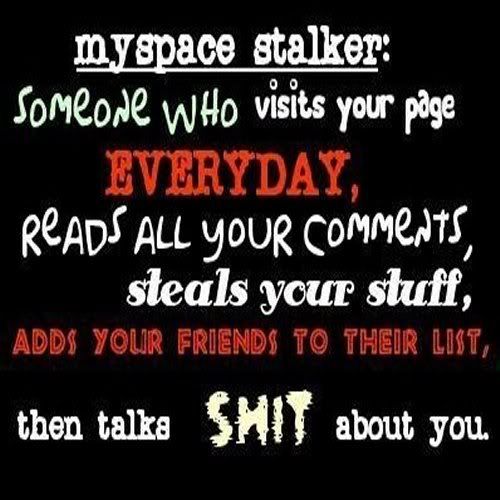
Myspace Stalker Pictures, Images and Photos
Media mogul and grumpy old man Rupert Murdoch has developed a "personal antipathy to the Internet," biographer Michael Wolff writes. Murdoch even thinks MySpace, which he himself paid $580 million for, is kind of a criminal piece of garbage:
In 2005, not long after News Corp. bought MySpace, when it still seemed like a brilliant purchase... I congratulated him on the acquisition. "Now," he said, "we're in the stalking business."

Later in his Vanity Fair column, Wolff recounts how Murdoch asked the founders of Google "Why don't you read newspapers?", gave "a walleyed stare" during all conversations about Web news and tried to beat Facebook's Mark Zuckerberg to death with his cane.

Kidding; even after buying MySpace, Murdoch was over the moon for Zuckerberg. He invited the founder to speak at a News Corp. executive retreat, huddled with him throughout dinner — sparking obvious jealousy in MySpace co-founder Chris DeWolfe — and soon declared people were "all going to Facebook at the moment" rather than MySpace. All this according to Julia Angwin's Stealing MySpace.

The point is, Rupert Murdoch has always kind of hated on MySpace, cruelly, in public.

original article here

Friday, September 18, 2009

Two Arrested for Cyberstalking

myspace Pictures, Images and Photos
(LOUISIANA) Two women were arrested on charges of cyberstalking Thursday for sending threatening messages through Myspace, deputies said.

Latasha Renee Charles, 21, 318 Railroad Ave., and Aalijah Monique Charles, 26, 1 Stonesthrow Drive, are accused of threatening bodily harm against a 25-year-old woman in the messages, Sheriff’s Maj. Malcolm Wolfe said. Deputies viewed several messages allegedly sent by the pair after the 25-year-old contacted authorities, he said.

The woman confirmed they sent the message after their arrest, Wolfe said.

Both have been released from the Terrebonne Parish jail, authorities said.

original article here

Wednesday, August 05, 2009

"He Put Nude Photos of Me on MySpace!"


By Diana Hefley

(U.S.A.)An Eastern Washington man accused of firing off nearly 100 harassing text messages to a Stanwood teen and posting naked pictures of the girl on MySpace is now charged with a felony.

Prosecutors charged the Selah man, 18, earlier this week with cyberstalking after a 15-year-old girl complained that the man sent her threatening text messages after she broke off their long-distance relationship.

Police also learned that the man created a MySpace page and posted nude photographs of the girl on the site. The girl had sent the photographs to him from her cell phone — a practice referred to as “sexting.”

“There is no such thing as privacy over the airwaves or Internet. If you send it, you lose all control over what someone does with it later,” said Snohomish County deputy prosecutor Mark Roe, who leads the special assault unit.

Photographs a person sends to a current love interest can easily be distributed to someone else, he said.

Prosecutors have seen an increase in people using text messages to harass victims, including sending sexually explicit images.

State legislators five years ago enacted a law against cyberstalking to address harassment, intimidation and public embarrassment using electronic devices, such as e-mail and cell phones. Lawmakers were moved to action after learning of a Seattle woman whose ex-boyfriend relentlessly sent e-mails loaded with lies about her to her friends and co-workers.

Federal anti-cyberstalking laws were enacted in 2006.

Arlington police began investigating the Selah man in March. The teen told investigators the man was someone she was friends with in grade-school and they began communicating on MySpace. A few months later the girl told the man she didn’t want to be his girlfriend because he lived too far away.

The man began barraging the girl with threatening text messages. court papers said. He threatened to hunt the girl down and told her he had dreams of killing her.

He sent about 90 text messages over five days, Snohomish County deputy prosecutor Laura Twitchell wrote. Police later viewed the MySpace page he created that featured nude photos of the girl.

The man allegedly told investigators he sent the girl naked pictures of himself. He also told police he had naked pictures of at least three other minors on his computer, Twitchell wrote.

He also told investigators he sent text messages to scare the girl, court papers said.

SOURCE

Sunday, August 02, 2009

Murder Suspect Cyberstalks Family

By Anthony Cormier

Leonard Patrick Gonzalez Jr. is charged in the Escambia County slayings. His daughter, ex-wife and former in-laws live in Sarasota.

Once or twice a year, Leonard Patrick Gonzalez Jr. would call the Herkel residence in Sarasota and demand to see his daughter.

Usually, Rebecca Herkel would try to placate her former son-in-law, who is now a suspect in the killing of a Pensacola couple last week, explaining that he lost his parental rights and needed to go through the legal system if he wanted visits with the girl.

But in April, Gonzalez took a new route: MySpace, and with it a new level of intensity that eventually amounted to cyberstalking.

Months before he was charged in the murderous home invasion near Pensacola that has shocked the nation -- a crime that led to the slaying of a couple that raised numerous foster children -- Gonzalez started a Web page devoted to the Herkels, who live in northern Sarasota and run Bill's Mobile Home Repair.

Gonzalez used MySpace, the social networking site, to make wild claims about the Herkels, post intimate photographs of the family and write fabricated claims from local public figures that suggested he had a right, and their support, to be in his daughter's life.

Authorities arrested Gonzalez, 35, on Sunday in connection with the slayings of Byrd and Melanie Billings in rural Northwest Florida, who were known for giving generously to schools and adopting children with special needs.

Seven people have been charged in all. Authorities say the group meticulously planned the break-in, wore ninja-style clothing and shot the couple during what appeared to be a robbery.

The murders left the Herkels shaken, wondering whether Gonzalez -- a karate instructor who raised his own family of six boys in Gulf Breeze -- was stalking them through MySpace and whether his violent online outbursts could have led to something worse.
"I don't think I'm qualified to get into his psyche," said Rebecca Herkel, whose daughter married Gonzalez eight years ago and was divorced two years later. "But I know that he is a truly diabolical man, an evil man."

Photos and fabricated testimonials were posted on his MySpace page, appearing to come from Sarasotans such as former Mayor Lou Ann Palmer, and business people including real estate broker Charles Knowles and banker Veronica Brady.

Gonzalez married Katie Herkel while she was away at college in Pensacola, but it was a rocky marriage that ended in 2002, according to court records. Herkel's mother says Gonzalez was supposed to have supervised visits with their daughter, Bella, but he failed to pay child support and did not take required parenting classes.

After his ex-wife won sole custody and moved back to Sarasota, Gonzalez would call the Herkels every few months and lash out at his former in-laws.

But the calls stopped recently, and it appeared that Gonzalez had turned to MySpace to gather information on the family and seek others to take up his custody battle. On the site, he posted the Herkels' home phone number. He wrote about his ex-wife's sister, posting her name, her work phone number and an e-mail address of a supervisor.

About his daughter, Gonzalez claimed: "She was taken from me, against my will several years ago, and I miss her very much. I have made many numerous attempts to be a part of my daughter's life, but they have kept her from me.... for NO GOOD REASON!!!"

Rebecca Herkel says the family called local law enforcement officials but were told that nothing could be done. The Sarasota County Sheriff's Office says that it has no record of meeting with the Herkels about Gonzalez.

Meanwhile, Gonzalez was also making up messages from local business leaders and politicians. He apparently copied their photographs from Web sites and claimed they were his online "friends."

One of his targets was Palmer, the former mayor. Gonzalez fabricated a message from Palmer saying that she would e-mail a lawyer's name and phone number for help. "Please feel free to call my private line once you have spoken with him to let me know how things are looking," the message claimed.

Palmer, reached Tuesday, said her relatives were shocked and scared that her photograph had appeared on the MySpace page. "I don't even use MySpace," she said.

In the last few weeks, the messages took on a more ominous tone.

June 21: "BIG REWARD FOR ANY INCRIMINATING INFORMATION OR PHOTOS OF THESE PEOPLE"

July 6: "We are getting closer."

July 9: "Making a move for humanity."

Then, on Thursday, several men were captured on a home surveillance system breaking into the Billingses' home, according to authorities.

Officials in Escambia County claim it was a well-planned attack, that two teams entered the front and rear of the home and silently killed the couple. One of the other suspects is Gonzalez's father, Leonard Patrick Gonzalez Sr., who drove the getaway van, authorities said.

"When I saw the newscast last night, I just knew that he was the mastermind," Rebecca Herkel said. "I said, 'Oh, it's him. He is diabolical enough to do that.'"

Herkel said she has not been contacted by law enforcement in relation to the Pensacola killings, and said she has no reason to believe there is any connection between Gonzalez Jr.'s stalking of her family and the Billings murders.

ORIGINAL STORY HERE

Monday, July 06, 2009

Guilty Verdict Overturned in Megan Meier Suicide Case

EOPC hopes this acquittal is appealled. Drew says she 'didn't read MySpace's Terms of Service. Ignorance may be bliss but it shouldn't stand up in court!

If you would like to contact Judge Wu and let him know why you disagree with his decision, please send an e-mail to his attention at his court clerk's e-mail.

wtf Pictures, Images and Photos

by Carolyn McCarthy

Lori Drew, the woman convicted of using a hoax MySpace profile to harass a teenage girl to the point of suicide, was acquitted by a Los Angeles judge on Thursday, Wired reported.

Judge George Wu overturned Drew's guilty verdict, which was issued in November, saying that if Drew had been convicted of a felony in the case, she would already have been sentenced. But because she was convicted of three misdemeanors -- a significantly lighter offense than prosecutors originally sought -- the constitutionality of the guilty verdict was less clear.

Drew, a Missouri resident, had been convicted of three misdemeanor counts of "accessing protected computers without authorization to obtain information to inflict emotional distress," each of which could have resulted in a year of jail and a $100,000 fine. But she hadn't been convicted of conspiracy, a felony that could've led to up to 20 years in prison.

The tragic situation unfolded in 2006, when Drew, her teenage daughter, and an 18-year-old employee of the family created a fake MySpace profile for a fictitious teenage boy that they used to harass one of Drew's daughter's classmates, 13-year-old Megan Meier. Meier hanged herself.

This was a situation in which traditional law did not align smoothly with the realities of the digital world: the prosecutors' argument was rooted in a terms of service violation, since MySpace officially outlaws impersonation and fictitious accounts.

Last year, the Electronic Frontier Foundation urged the courts to dismiss the case because of the precedent it could set. "Criminal charges for a 'terms of service' violation is a dramatic misapplication of the CFAA (Computer Fraud and Abuse Act), with far-ranging consequences for American computer users," the EFF said at the time, and argued that it could result in criminal charges for something as innocuous as a minor using the Google search engine.

Drew's lawyers had argued that the law being used against the defendant was vague and flawed, which the judge upheld Thursday when he threw out the guilty verdict. The Computer Fraud and Abuse Act is typically used against malicious hackers.

According to Wired, the judge argued for nearly 45 minutes with U.S. Attorney Mark Krause over the specifics of the CFAA.


If you would like to contact Judge Wu and let him know why you disagree with his decision, please send an e-mail to his attention at his court clerk's e-mail.
javier_gonzalez@cacd.uscourts.gov

Monday, April 06, 2009

Trying to Recruit Prostitutes - Through MySpace

By Helen Croydon

Ordinary women are being lured into prostitution through networking sites with offers of glamour and cash.

MYSPACE Pictures, Images and Photos

After a friend was approached through her MySpace profile with the promise she’d “earn £100 an hour having fun”, I went undercover to find out exactly what these girls are being lured in to.

The flattering email – from “Jules” – complimented her on her appearance and told her she’d be able to “select the type of clients she sees and approve every appointment”.

It also assured her that security checks would be taken care of.

So, to expose the reality, I emailed Jules, calling myself Charlotte and pretending to be interested.

Two days later I turned up to meet her at a London Tube station, armed with a small bag of clothes.

She’d asked me to bring a selection of sexy outfits so she could take photographs and put my “working” profile up on the web right away.

Jules reeked of alcohol and later apologised for “being a bit tipsy”. She’d been with a client that day and had been drinking champagne. “You get a lot of that in this job. So if you like champagne you’re on to a winner,” she laughed.

We settled into a nearby Starbucks and she immediately reassured me: “You’ve got the job by the way. This is not really an interview – if we like the look of you, you can start.”

She didn’t ask about my background, my age, whether I’d done this before and she didn’t question my emotional state.

The only questions she asked me in the course of our two-hour meeting were what sexual acts I was uncomfortable with and what days I was unavailable to work.

She never once made any reference to safe sex or asked if I’d had sexual health checks myself.

She told me the going rate is £100 an hour. She charges a £25 booking fee plus a £10 fee for every hour.

But for the first five bookings, she takes an extra £10 per hour because she claims it takes extra time to push the profiles of new girls. That means her recruits are expected to perform a series of sexual acts for just £55, and to arrange their own transport.

“We used to be able to charge more, but with the credit crunch it’s gone down, and there are much less overnight stays,” she said. “You would have got a lot for those – around £800.”

Jules explained that the price could vary from week to week.

“If we find you’re getting loads of inquiries we might put your prices up but if you’re not getting much response from the website, and it does happen, we’ll have to put your prices down.”

I asked her how the security checks were done. “Oh, that’s Jonathan, he does all the client side of things, I don’t know how he checks, but trust me, he does.”

Having supposedly calmed my fears about safety, she went on to paint a glamorous picture of a life full of luxury hotels and gifts. “I’ve not bought perfume for two years,” she bragged.

“You’ll meet so many interesting people. I’ve had all sorts of clients from High Court judges to electricians.”

After a half-hour chat, she was keen to get me to the hotel to do the paperwork. She had a room booked that she’d used to entertain a client earlier.

She wanted to use the room to photograph me. I asked if we could do the paperwork in the hotel bar – unwilling to have my photos taken by a stranger.

Jules ordered a large glass of wine and water for me then produced three sheets of paper.

The first page asked for my real name, a “working name” and physical details such as height, bra size and eye colour.

I gave a false name but she never checked my ID. If I ever went missing on a job – how would anyone find me?


The second page was to select the type of male client I’d prefer. The third listed the sex acts I may be expected to perform. They were colour coded: white for what was “normal”, yellow for “what I can refuse to do” and blue for what would merit “extra payment”.

The “extras” included “unprotected sex” and “unprotected sex until completion”. There were some phrases I’d never heard before. Jules didn’t offer to explain them.

After half an hour another girl joined us for the photo session. Jules had recruited her the day before.

Jane (her “working name”) was mouse-like. “I’d never normally do this,” she confessed as Jules went outside for a cigarette, “but so many things are bad in my life right now.

“I split with my boyfriend and then I lost my job and I just can’t get anything. I went to two other agencies from an advert on the internet. But both of them ripped me off.”

She reluctantly told how she’d given them an “appointment fee” of £200 or more then the so-called agencies disappeared without trace. “I have bills to pay, and this could just be what I need,” she concluded.

Worryingly, she seemed to genuinely believe that escorting was a good way of getting out of a bad situation.

Even more alarmingly, despite admitting she was in a very vulnerable state of mind, she was willing to be represented by a stranger who contacted her on the internet.

Certain types of prostitution are legal in the UK but for girls who chose to do it there is a significant risk to personal safety and emotional stability.

Chris Student from the International Union of Sex Workers warns: “I’d never encourage this type of work. But if people are going to do it they need to know exactly who they are working for, get ID, ask to meet other workers. This is an industry where there is a particular danger.”

Jules was persuasive and charming and it’s easy to see how girls hungry for money could trust her – and her reassurances that male clients go through security checks.

But what she does is another argument against having an open profile online. Anyone could be studying your photos, sizing you up as a possible sex worker.

Jules told me MySpace kept deleting her account when they found out she was contacting potential recruits. But it didn’t deter her. “I just start a new profile up again,” she laughed.

A MySpace spokesperson said: “We have measures to monitor emails, but unless something in the language triggers an alert, we can’t investigate. If someone reported a potential abusive email, we’d look into it.”

Excerpt from the MySpace email:
Hiya, you seem like an adventurous, fun-loving girl… perhaps you’d be interested in this?

Would you like to earn over £100 an hour having fun, part-time, with flexible hours to suit you? Working as little or as much as you want?

I’m an escort working together with part-time girls from 18 to 35 who earn on average over £100 an hour. Everyone works flexibly with hours to suit them – some work up to 10 hours a week, others only a couple of hours a month – it’s entirely up to you.

All the girls choose the kind of client they see and approve every appointment before it’s finalised.

The agency does all the marketing, sales and security so you have nothing at all to bother about except the appointments.

Thanks

Kisses, Jules

SOURCE